How to Lower Your A1C, Support Your Other Conditions, and Get Your Strength Back
“I’ve been on the A1C battle for over a year and a half.” “I want to reverse pre-diabetes and stay in the 5.4 range.” “To increase activity, reduce inflammation, lower cholesterol, and get…

“I’ve been on the A1C battle for over a year and a half.” “I want to reverse pre-diabetes and stay in the 5.4 range.” “To increase activity, reduce inflammation, lower cholesterol, and get my blood sugar in check. To live a long, active, pain-free life.”
If more than one thing is going on in your body at once, you know the particular exhaustion that comes with it.
You fill the pill organizer Sunday night while the kettle boils — blood pressure med, statin, thyroid, the metformin you’ve been told is coming, the vitamin D, the magnesium that helps you sleep. You check the lab portal on your phone the way you’ve been checking it for years. A1C climbing two points, then settling. LDL stubborn. CRP that won’t quite come down. Numbers as familiar to you as your kids’ birth weights.
You’ve collected dietary advice the way you’ve collected the medications — a handout from one doctor, a contradiction from the next, a relative who swears by carnivore, a friend who lost 30 pounds on Ozempic and keeps asking. Each conversation contradicts the last. You’ve stopped knowing what to eat for breakfast.
The heaviest part is the daily food math. Did I have too many carbs at lunch? Will my sugar be high at bedtime? Is this the eggs that’s nudging my LDL up? The annual physical comes around and your shoulders rise the morning of. Your daughter calls and asks how the numbers are. You tell her they’re working on it — because they is easier to say than I.
This is what trying to manage multiple conditions on multiple plans does. The exhaustion isn’t from any individual day. It’s from years of fragments.
Medicine is organized by organ system. The body isn’t.
Every dietary plan you’ve been handed addresses one organ at a time — glucose at endocrinology, lipids at cardiology, inflammation at integrative medicine. Each is doing the job it was trained for. What gets missed is that you aren’t a stack of organs. You’re one body, and the conditions sit on top of each other at the same upstream node.
When the A1C drifts up, the LDL drifts up. When the LDL drifts up, the CRP drifts up. When the CRP drifts up, joint stiffness comes earlier in the morning and brain fog comes later in the afternoon. The midsection that’s grown since your fifties is part of the same picture. The 3 PM crash is part of the same picture. The 3 AM wake-up is part of the same picture. The specialists are separate. The conditions are not.
The research has been making this case for twenty years. A recent systematic review in the BMJ pulled 29 randomized controlled trials of low glycemic index dietary patterns in people with diabetes. One intervention — one way of eating — improved A1C, fasting glucose, body weight, LDL cholesterol, and C-reactive protein at the same time (Chiavaroli et al., 2021). Not five separate diets. One.
Further upstream, the landmark Diabetes Prevention Program trial reduced the progression from prediabetes to type 2 diabetes by 58% through diet plus modest activity — outperforming metformin (Knowler et al., 2002). When the diet is the right diet, it moves the upstream picture more than the medication targeting one downstream effect.
That’s what the three changes below do.
What your body and your bloodwork look like once the framework lands
It’s a Tuesday morning. You’re at your annual physical. The nurse takes your blood pressure and you don’t brace for the number. The doctor pulls up your labs from last week. Your A1C has come down from 5.8 to 5.4. Your LDL is 118. Your CRP is 1.4. Your fasting glucose is 91. The doctor pauses, looks at you, and asks — what have you been doing?
You tell her. She writes it down. She asks for the name of the program.
That’s one of the moments on the other side of this.
The day-to-day version is quieter. You get up Wednesday morning and the stairs to the kitchen aren’t a project. The stiffness that used to take an hour to ease out of your hips has shortened to twenty minutes, then to ten, then to almost nothing. You carry the laundry basket up two flights without setting it down halfway. You get up from the garden after weeding for thirty minutes without holding onto the fence. Your husband notices you’re keeping up on the walks again.
Your energy steadies. The afternoon crash that used to put you on the couch by three has been gone so long you’d forgotten it used to happen. The 3 a.m. wake-up doesn’t come anymore. Your sleep is deeper. The brain fog that used to come and go has lifted to the point that you finished the book you’d been restarting for two years.
The daily food anxiety — the small math problem at every meal — quiets. You stop checking the lab portal between appointments. You stop dreading the annual physical. You stop carrying the they around. When your daughter calls and asks about the numbers, you say I’m doing it — and it’s working.
Your joints feel less stiff in the morning. The waistband that used to dig in by noon doesn’t. You catch yourself laughing at something on the radio while you’re making dinner, and you realize you couldn’t have remembered the last time something on the radio made you laugh.
This is what strength, energy, joy, and lower anxiety actually look like when they show up. Not all at once, and not as separate gifts — they show up because the underlying picture has changed.
Three changes move it all together
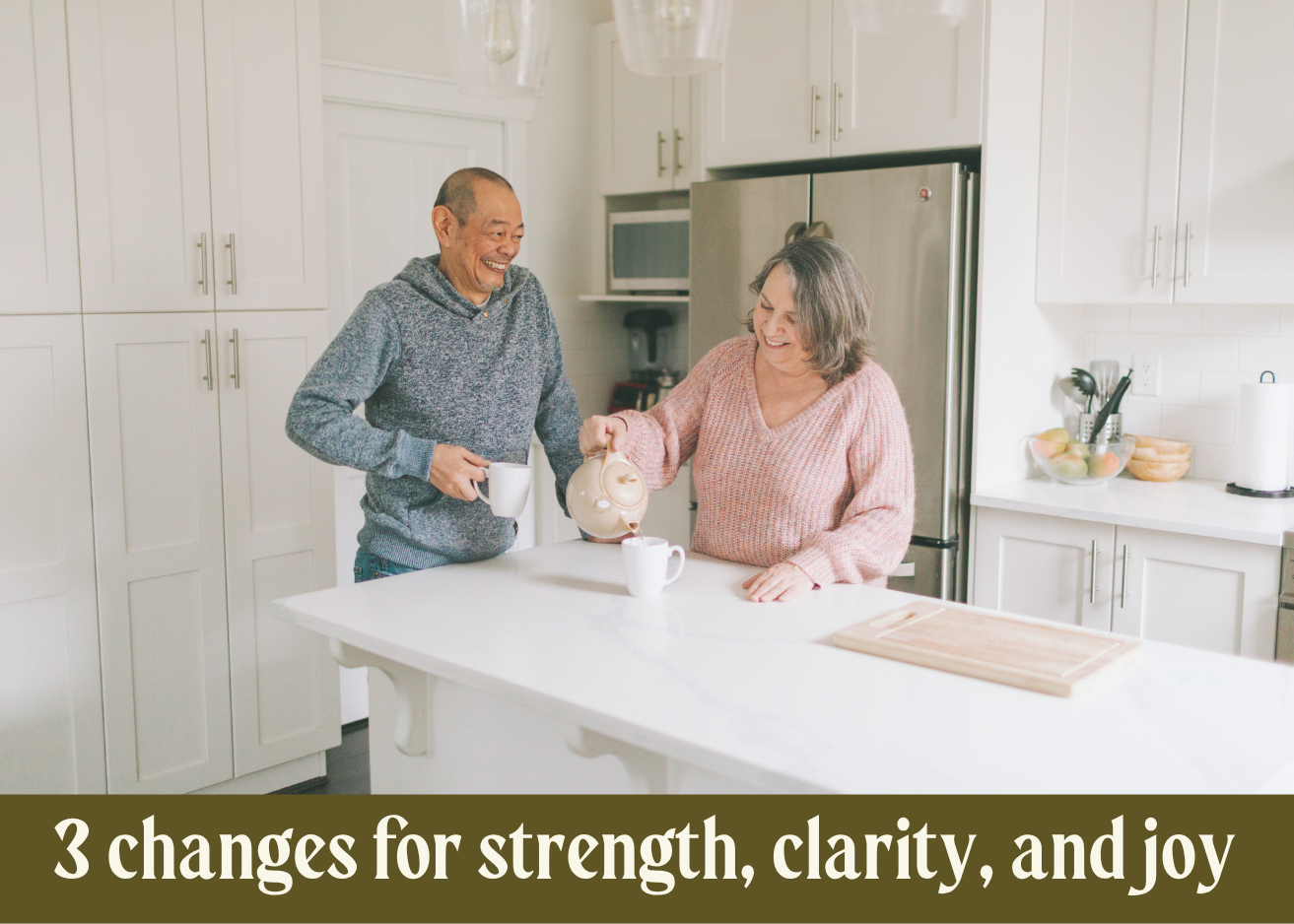
Three shifts together replace the fragment-care exhaustion with one framework that handles it. The first is the structural one, and the most freeing.
1. One framework, not a stack of plans
The reason most women juggling multiple conditions stay stuck isn’t lack of effort. It’s the impossible math of trying to satisfy three or four contradictory food rules at once.
The diabetic plan says eat eggs for protein. The cholesterol plan says cut egg yolks. The autoimmune protocol says no eggs at all. The plant-forward dietitian says more whole grains. The keto-curious functional-medicine doctor says no grains. Every one of these recommendations is grounded in a real concern about a real organ system. Every one of them, taken in isolation, will partly help. Stacked together, they cancel each other out — and they leave you with no actual meal to make on a Wednesday night.
What replaces this isn’t a fifth plan. It’s a framework that targets the underlying mechanism — glucose variability — that almost every one of these conditions has in common.
When your blood sugar spikes and crashes through the day (the high-GI cycle most modern diets create), the downstream effects are everywhere. Your liver makes more LDL cholesterol. Your inflammatory markers (CRP, IL-6) drift up. Your insulin works harder, your A1C drifts higher, the weight settles in your middle. The 3 PM crash sends you for sugar. The 9 PM craving sends you for something refined. The brain fog and the joint stiffness — the things you’ve been chalking up to age — are downstream of the same chemistry. The conditions look separate because the specialists are separate. They aren’t separate.
That’s the Whole GI Protocol. It isn’t a “diabetic” framework or a “cholesterol” framework or an “anti-inflammatory” framework. It’s a framework for stabilizing the day’s blood sugar — using the daily flow, the substitution moves, and the way of seeing your plate that goes with it. The downstream effect is that multiple conditions improve in parallel.
What “one framework” looks like in practice:
You eat the same daily flow whether you’re addressing A1C, cholesterol, joint inflammation, or all three. You don’t need to switch protocols when you add a new condition or get a new diagnosis. You don’t need to apologize to your endocrinologist for what your cardiologist told you. You eat the framework.
The same Wednesday-night dinner — a piece of salmon, a serving of quinoa, sautéed greens with olive oil, a small piece of dark chocolate at the end — does all of the following at once: stabilizes blood sugar, supports HDL, anti-inflammatory through the omega-3s and polyphenols, protein-adequate for muscle support, satisfying enough that you don’t snack at 9 PM. Not four meals for four conditions. One meal for one body.
What I’ve watched one framework do that the four-plan model can’t:
The women who try to follow multiple plans burn out by month two — not because they aren’t trying hard enough, but because the math is genuinely impossible. The women who get traction are the ones who find one framework that handles the whole picture and let go of the four separate ones. The relief is immediate. The food anxiety lifts within two weeks. The bloodwork starts to follow within ninety days.
2. Blood sugar is the lever — move it, and everything else moves
The second change is what makes the framework above work biologically. It’s worth understanding, even briefly, why one lever moves so many things at once.
When you eat a high-GI meal — refined bread, white rice, sugar, juice, most cereals, most snack foods — your blood sugar rises sharply. Your pancreas releases insulin to bring it back down. The blood sugar drops, often past the comfortable middle, into the territory where you feel shaky and reach for something sweet. Your body has just done a lot of work to handle that single meal.
Now do that three meals a day for thirty or forty years. The pancreas works harder. The insulin response gets less precise. Your fasting glucose drifts up. The A1C — the rolling 90-day average — climbs.
But that’s only the diabetes story. The same glucose variability also drives:
Liver lipid production. When your blood sugar swings high, your liver makes more triglycerides and more small-particle LDL — the cholesterol your cardiologist is worried about.
Systemic inflammation. Repeated glucose spikes drive low-grade inflammation that shows up on bloodwork as elevated CRP and on your body as joint stiffness, brain fog, and slower recovery from anything.
Visceral fat deposition. Insulin-driven fat storage prefers the middle. This is why the midsection gets bigger in women after 50 even when they’re not eating more.
Energy crashes and sleep disruption. The 3 PM slump and the 3 AM wake-up are both blood-sugar events.
Brain fog and mood. Glucose variability affects cognitive function and mood regulation — there’s good evidence that stabilizing it lifts both.
So when you stabilize the blood sugar — through low-GI eating, the daily flow, the post-meal walk — you don’t just lower the A1C. You move the LDL, the CRP, the visceral fat, the energy, the sleep, the cognition, and the mood. All at the same time. Because they’re all downstream of the same lever.
The Diabetes Prevention Program trial demonstrated this years ago. The lifestyle intervention group — diet plus modest activity — saw a 58% reduction in progression to type 2 diabetes, a 9% reduction in cardiovascular risk markers, and improvements in inflammation and weight, all from the same intervention (Knowler et al., 2002). One change, multiple gains.
What the arc looks like for women in this community:
Weeks 1–2: Energy steadier. Sugar cravings noticeably lighter. Sleep starts to improve. (The scale might not move yet — that’s normal.)
Weeks 3–6: Fasting glucose comes down. Waist measurement starts to come in. Clothes fit differently before the scale shows it. The afternoon crash is gone. Inflammation markers (joint stiffness, brain fog) start to ease.
Weeks 6–12: Weight moves. A1C at the 90-day blood draw shows real drift. LDL starts to soften. CRP often comes in lower than it was. The internal food monologue gets quiet.
Months 4–6: Bloodwork stabilizes in a better range. Strength is noticeably better — the stairs, the laundry basket, the garden. Mood lifts. Sleep is consistently deeper.
Year one: The weight is durably off. The lab portal has a year of improving trends. The doctor’s office is a different experience. The framework has become how you eat.
The compound effect — and what it means for your bloodwork:
When you treat each condition with its own diet, your effort spreads across four targets and hits none of them squarely. When you target the shared upstream lever, your effort compounds — every meal that stabilizes blood sugar is also lowering inflammation, also supporting lipids, also protecting cognition. The result is faster, more durable, and less exhausting. The women who get the strongest results are the ones who stop trying to address each marker individually and trust that the framework handles them together.
3. Protect your strength while you lower the numbers
The third change is the one most “diabetic diets” and “cholesterol diets” get catastrophically wrong, especially for women 55 and older.
A diabetic diet, as it’s usually written, is built around restriction. Cut the carbs. Cut the sugar. Cut the portion sizes. Lower the calories. The number on the scale comes down. The A1C creeps down a little. From the bloodwork standpoint, it looks like progress.
But here’s what the bloodwork doesn’t show: in restricting calories without prioritizing protein, you’ve been quietly losing muscle. Sarcopenia — the gradual loss of skeletal muscle mass — accelerates after 50 and accelerates further on protein-inadequate diets. Most “heart-healthy” and “diabetic” eating patterns women over 55 are handed are below the protein threshold that maintains muscle. So while your A1C is dropping, your strength is dropping too. Your grip weakens. The stairs feel longer. Getting up from the garden takes a little longer than it used to. The number on the scale is moving in the right direction, but the body underneath is getting more fragile.
For women in their 60s and 70s, this is the trade nobody named. Lower the numbers, lose the muscle. Win the lab result, lose the independence.
It doesn’t have to be that trade.
The Whole GI Protocol is built with a non-negotiable protein floor — 25 grams of protein at breakfast, minimum. Plus protein-anchored midday and evening meals. The math is intentional: 25 g at breakfast is the satiety threshold (below it, you don’t get the morning fullness; at it, you do) and it’s the muscle-synthesis threshold for women in their 50s, 60s, and 70s. The same anchor that holds the blood sugar steady also stimulates muscle protein synthesis. You can lower your A1C and maintain — or build — strength.
What “protein-anchored” looks like at breakfast:
Three eggs scrambled with a slice of cheese and a handful of spinach (about 27 g protein)
A Greek yogurt bowl: 1 cup full-fat plain Greek yogurt + 2 tbsp chia seeds + berries + a handful of walnuts (about 25 g)
Cottage cheese with sliced peach and almond butter (about 26 g)
A smoothie built around 1 scoop whey protein + 1 cup unsweetened almond milk + frozen cauliflower + berries + 1 tbsp peanut butter (about 28 g)
Smoked salmon on a slice of sprouted-grain toast with cream cheese and capers (about 25 g)
The midday meal stays protein-anchored too (a piece of fish, chicken, or eggs with vegetables and a real serving of a low-GI starch). The mid-afternoon snack has built-in protein (a hard-boiled egg, a slice of cheese with an apple, hummus and cucumber). Dinner anchors on protein again. By the end of the day, you’ve hit somewhere between 90 and 130 grams of protein — comfortably above the threshold that protects skeletal muscle.
The walking matters too. A 10-minute walk after each main meal does two things at once: it pulls glucose into the muscle (improving A1C and insulin sensitivity) and it loads the bone and joint enough to maintain density and mobility. One small habit, two systems supported.
The trade nobody named — and why you don’t have to make it:
Too many women in their 60s and 70s come to me from “successful” diets having lost weight and lost their strength at the same time. The number on the scale was down. Their grip strength was down too. They were lower-A1C, lower-LDL — and more fragile. That isn’t a win. The whole point of moving the labs is to get the body that carries you through the rest of your life. A body that’s metabolically improved and structurally weakened isn’t that body. The protein-anchored framework gets you the metabolic improvements and the strength. Both. Together.
This becomes especially important for women on GLP-1 medications (Ozempic, Mounjaro, Wegovy). These medications work in part by reducing appetite — which means many women on them eat far less, often skipping breakfast and barely eating at lunch. Without an intentional protein floor, GLP-1-induced weight loss has a high rate of muscle loss alongside the fat loss. The framework above — and the personalization Olive offers around GLP-1 use — protects the strength while the medication does its work.
The body you build through the framework isn’t smaller and weaker. It’s metabolically better and structurally stronger. That’s the body that carries you into your 80s.

“I’m on multiple medications. Will this conflict with them?”
No, and in most cases it’ll make your medications work better.
Low-GI eating doesn’t interact pharmacologically with any common medication. What it does is reduce the demand on the systems your medications are supporting. For a woman on metformin and a statin, lowering glucose variability through the framework reduces the load on both — and it’s common (with your prescribing doctor’s involvement) to see medication doses reduced or eliminated over six to twelve months as the bloodwork stabilizes.
The one situation where active coordination matters: if you’re on insulin or a sulfonylurea, your blood sugar response to low-GI eating will be different and your doctor will want to monitor for low blood sugar episodes in the first few weeks. The Custom Plan flags this, and Olive will remind you to coordinate with your prescriber. Otherwise, the framework is designed to work alongside whatever your physician has you on.
“I have allergies and other dietary restrictions. Won’t this be too restrictive on top?”
No — and this is one of the framework’s strengths.
Low-GI eating isn’t an elimination protocol. It’s a framework that works around whatever you’re already restricting. If you can’t have dairy, the protein-anchored breakfast still works (eggs, smoothies with non-dairy milk, plant-based protein options). If you’re gluten-free, the daily flow doesn’t require gluten at all. If you have nightshade restrictions or shellfish allergies or histamine sensitivities, the Recipe Finder filters them out and Olive defaults to your dietary file every time you ask a question.
The Custom Plan captures all of your restrictions when you sign up. From that moment forward, the framework respects them. You aren’t piling another set of rules on top — you’re getting a framework that already knows.
“Will my doctor approve of this approach?”
In almost every case, yes. The Whole GI Protocol is consistent with the dietary recommendations of the American Diabetes Association (which now explicitly endorses low-GI eating as one valid pattern), the American Heart Association (which has supported low-GI patterns for cardiovascular risk reduction for over a decade), and most integrative-medicine perspectives on inflammation. The two research citations above — the BMJ meta-analysis and the NEJM DPP trial — are both standard references your doctor will recognize.
If you want to bring it up at your next appointment, the cleanest framing is: I’m working on a low-glycemic-index eating pattern and tracking my A1C, LDL, and CRP. I’d like to see if we can revisit my medications in 90 days if the numbers move. Most doctors are quietly grateful to have a patient doing the work.
Three changes. One framework. One body.
One framework, not a stack of plans. Target the upstream lever, and the conditions move together.
Blood sugar is the lever — move it, and everything else moves. A1C, LDL, CRP, weight, energy, sleep, mood — all downstream of the same thing.
Protect your strength while you lower the numbers. A protein-anchored daily flow that improves the labs and the body underneath them.
One framework. One body. One way of eating that handles A1C and cholesterol and inflammation and energy together — instead of four contradictory diets that ask you to be four different women at the same kitchen table.
If you’ve been juggling multiple conditions on multiple plans for years — for decades — there’s a way to consolidate. The first month is for orienting to the daily flow. The second is for watching the energy steady. The third is for the bloodwork that shows what’s been quietly moving underneath. By month six, the doctor’s office is a different room. By year one, the conversation with your daughter changes.
This is the body that carries you forward — strong, energized, clear-headed, and out of the daily food math that’s been wearing you down. Not by adding another rule to your life. By replacing four rules with one framework that handles them all.
Take 24 hours and see.
Start Low GI Living with a 24-hour free trial. No credit card.
Fill out a short health survey. Get a personalized Custom Plan tuned to your specific lab values, medications, and dietary needs. Walk through the Whole GI Protocol class. Open your Goal Report to see all your markers in one place. Ask Olive how to handle a specific condition or medication. Meet the Members’ Community of women managing exactly what you’re managing.
Twenty-four hours from now, you’ll know whether this is different. If the framework lands — if the daily food math finally stops because one approach handles everything — the second day starts the same way. As does the third. The week after that. The year after that. The doctor’s office a year from now.
Start your 24-hour free trial →
Already completed the trial? Great! Let’s pick up where you left off.
Kindly,
Jen