What to Do With Summer Fruit When You’re Watching Your Blood Sugar
”My nutritionist wants me to eat more carbs but I’m afraid…
”My nutritionist wants me to eat more carbs but I’m afraid to.”
A woman in our community wrote that to us this spring, and it stayed with us — because it holds two true things at once. She has been told to eat the carbs. She is also genuinely afraid of what they do to her. Nobody ever explained how both of those could be right at the same time.
July is when this gets loud.
The peaches are actually good right now. There’s watermelon at every cookout. The cherries will be gone in three weeks and you know it. And somewhere behind all of it sits the number your doctor mentioned at your last appointment — the A1C that has been inching up, the “borderline” that wasn’t there a few years ago.
So you stand in front of the fruit bowl doing the arithmetic you’ve been doing for years. Am I allowed to have this?
It’s the wrong question. And it isn’t your fault that you’re asking it, because the two answers you’ve been handed are both useless.
The two answers you’ve already been given
The first one says fruit is sugar, and sugar is the problem, so cut it. Berries only, maybe, if you’re good.
The second one says fruit is natural, it comes packaged with fiber and water, so eat as much as you want.
Both of them leave you standing there alone with the bowl. Neither one tells you the thing that actually determines what happens next in your body, which is not whether you eat the peach.
It’s what else is on the plate.
What actually happens when fruit travels alone
Fruit eaten by itself — on an empty stomach, at three in the afternoon, with nothing else alongside it — arrives fast. There’s very little to slow it down. Your body answers that arrival the way it’s supposed to, and then, forty minutes later, comes the dip: the flatness, the fog, the sudden hunger that makes no sense because you just ate.
One woman in our community described it exactly: ”sugars and carbs cause sugar crashes 30 minutes to an hour after eating.” She wasn’t imagining it, and she wasn’t doing anything wrong.
Now take that same peach and put it on a plate next to some protein and some fat, at the end of a meal instead of the middle of an empty afternoon. Slower arrival. Gentler curve. Steadier landing.
Nothing was forbidden. Something was added.
That’s the entire idea, and it’s worth saying plainly: we don’t take the carb away. We give it company.
Three moves, and none of them involve giving anything up
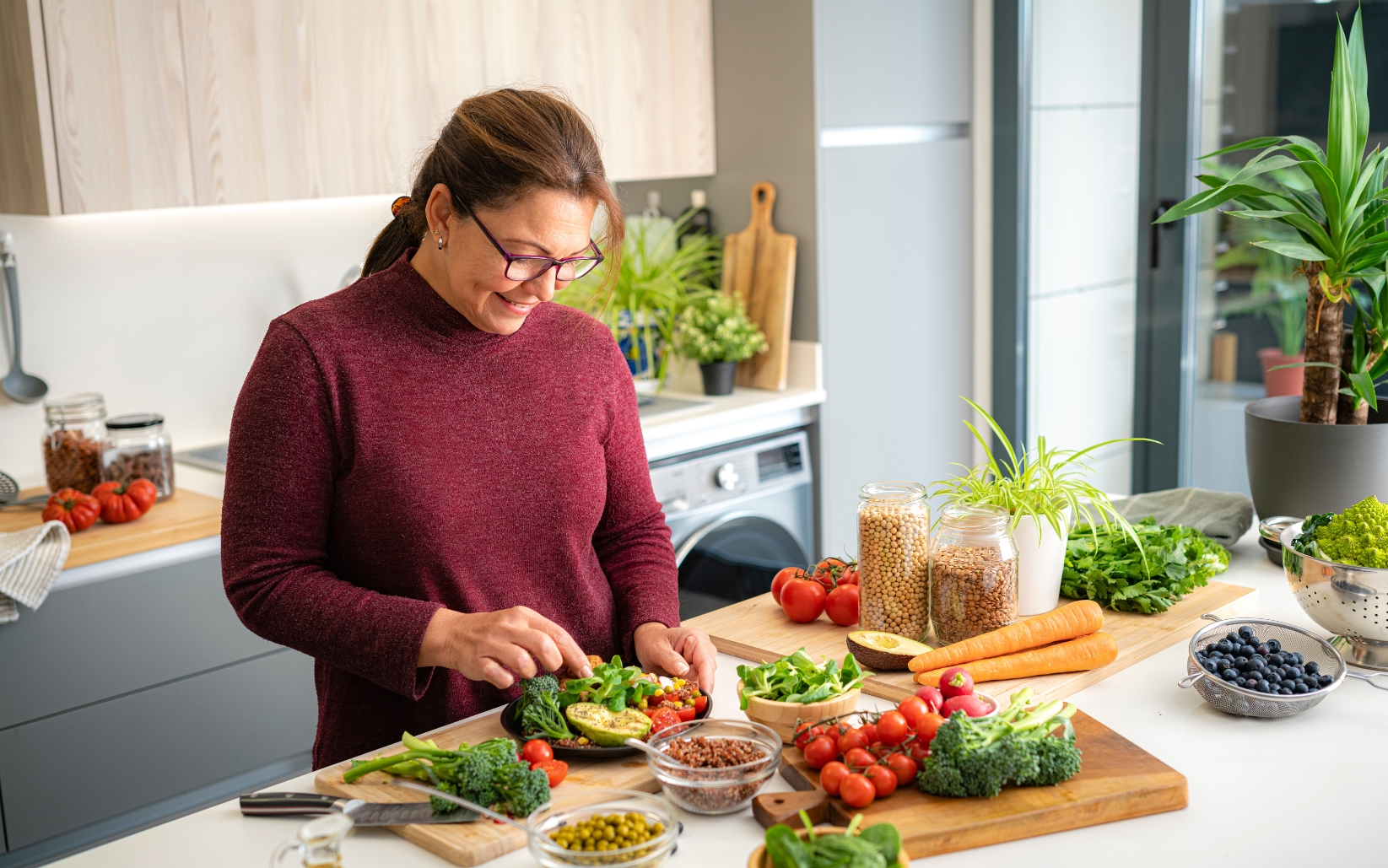
Pair it. Fruit should not travel alone. Give it protein and fat to walk with — a peach with cottage cheese, apple slices with almond butter, berries stirred into Greek yogurt, a handful of cherries after a meal that already had protein in it. This one move changes more than any food you could cross off a list.
Time it. Your body handles carbohydrate best in the middle of the day, when insulin sensitivity is at its highest. That’s why the protocol puts the starchy carb at lunch and leaves it off the dinner plate. Fruit follows the same logic. A bowl of fruit at nine at night, alone on the couch, is the hardest version of fruit there is. The same fruit next to your lunch is the easiest.
Sequence it. Vegetables and protein first. The sweet thing last. Eating in that order meaningfully changes how your body responds to the same food — same plate, same calories, different order, different result. Let fruit be the closing note of a meal rather than the opening one.
Not every fruit behaves the same way
This is where nuance actually earns its keep, so here it is without a list of banned foods.
Berries are the gentlest of the bunch — blueberries, raspberries, strawberries, blackberries. High in fiber, low in impact. These are the ones you can be most relaxed about.
Stone fruit and apples — peaches, plums, apricots, cherries, pears — sit comfortably in the middle. Portion and pairing do the work here. A peach with your lunch is a well-timed carb. Four peaches standing at the kitchen counter is a different event.
Melon, pineapple, grapes, and a very ripe banana move faster. They are not off the table — nothing here is off the table — but they want a firmer hand. Keep the portion honest and never let them travel without protein.
Juice and dried fruit are where we do draw a real line, and not for moral reasons. When you juice an orange, the fiber that was supposed to slow it down goes in the bin. When you dry a grape into a raisin, you’ve removed the water and concentrated everything else — a small handful is a great many grapes with the brakes taken off. Blend a raspberry, though, and the fiber is still right there in the glass. The difference isn’t the fruit. It’s whether the structure survived.
If you’re a member, this is exactly what the Low GI Food Finder is for — look up any food, get the real answer, stop guessing at the grocery store.
One July day, and not a recipe in sight
Because half of you have told us plainly that you don’t like to cook, hate meal planning, and need food you can grab.
Morning: 16 ounces of water before anything else. Then 25 to 30 grams of protein in the morning — eggs, or Greek yogurt, or a protein shake. Berries go on top of the yogurt, not alone in a bowl.
Lunch: the big flexible meal, and the one place a starchy carb belongs if you want one. Greens, protein, something with substance. Finish with sliced peach.
Mid-afternoon: if the 3pm dip arrives, that’s not a personal failing — it’s the moment the protocol plans for. Protein and fat. A few cherries alongside if you want them.
Dinner: protein and non-starchy vegetables. No starchy carb. This is the one that supports the overnight work.
Evening: herbal tea — cinnamon, ginger, chamomile. And if you genuinely want something sweet, a small bowl of berries with a spoonful of Greek yogurt is a closing ritual.
Nothing on that list required you to cook. Just guidelines for how you eat when it’s time.
The part we most want you to hear
You have been told, for years and by many people, that the answer to a number that’s creeping up is to remove something. Remove the fruit. Remove the bread. Remove the pleasure, and remove it quickly.
And you’ve done it. Probably more than once. And you watched it hold for a while, and then quietly stop holding — which is what one woman in our community meant when she said, ”I lose then gain it all back and more.”
Removal isn’t what steadies blood sugar. Structure is.
So eat the peaches. Eat them with protein, in daylight, at the end of the plate instead of the start of it. That isn’t a lesser version of summer or a compromise you’re settling for. It’s the version your body can actually keep up with — and most women tell us they feel the difference in their energy and their evenings well before anything shows up on a scale or a lab report.
One last thing, and we mean it: if your numbers are something you’re actively working on, keep your doctor in the loop. Bring your A1C and your questions to your next appointment. This is food, not medicine, and the two do their best work when they know about each other.
If you want to know where your numbers actually sit, our free 2-minute assessment builds you a Blood Sugar & Weight Goal Report — where you are now, a realistic target, and a week-by-week path to get there. Every new account gets full access free for 24 hours, no credit card. Membership is $11.95 a month after that, and you can cancel whenever you like.
— The Low GI Living team
P.S. — We’re curious. Which summer fruit are you least sure about? Come tell us in the Low GI Living Facebook group; we’re answering these all week. ❤️